


Has your personal data been recently exposed?
Check if information like your Social Security number, email, and passwords is exposed on the dark web.


You have reached the maximum number of scans allowed. Please come back after 24 hours.

Scanning the dark web...
Scanning public databases...
Scanning millions of records...
Narrowing down the search...
We need more information
Please enter a few more details to ensure we show you the right information.
You’re at high risk
We found your personal information on the dark web and on data broker sites.
 Up to $3M Reimbursement for identity theft, with up to $1M for Stolen Funds†††
$10K Scam Reimbursement7
Scam Support
Credit, Checking and Savings Activity Alerts: Unlimited Accounts
Credit & Payday Loan Lock2
Credit Monitoring:
3 Bureau1
Automatic Data Broker Removal8
Dark Web Monitoring
Priority 24/7 Customer Phone Support
Up to $3M Reimbursement for identity theft, with up to $1M for Stolen Funds†††
$10K Scam Reimbursement7
Scam Support
Credit, Checking and Savings Activity Alerts: Unlimited Accounts
Credit & Payday Loan Lock2
Credit Monitoring:
3 Bureau1
Automatic Data Broker Removal8
Dark Web Monitoring
Priority 24/7 Customer Phone Support
LifeLock Total

No one can prevent all cybercrime or prevent all identity theft.
- Price valid for introductory term. After that, your price will renew at the standard price.
- Your subscription begins immediately after your transaction is complete. A payment method is required at sign-up for trials, and you will be charged at the end of your trial, unless canceled first.
- Prices are subject to change and may be charged up to 35 days prior to renewal. Cancel here or contact Member Services.
- Restrictions apply. Automatically renewing subscription required. If you're a victim of identity theft and not satisfied with our resolution, you may receive a refund for the current term of your subscription. See lifelock.norton.com/guarantee for complete details.
††† Up to $1 million coverage for Lawyers and Experts included with all plans. Reimbursement and expense compensation vary according to plan. Insurance benefits are issued by third parties. See lifelock.norton.com/legal for policy info.
1 Bureau Monitoring and Monthly Credit Report and Score / 3 Bureau Monitoring and Monthly Credit Report and Score.
2 Credit Lock cannot prevent all account takeovers, unauthorized account openings, or credit file inquiries. Deactivates if you downgrade or cancel your subscription.
7 Scam protection coverage as part of identity theft benefits is currently available to all customers residing in the United States, including U.S. territories and the District of Columbia, with the exception of residents of New York. Gen Digital is not a licensed insurance producer. Benefits under the Master Policy are issued and covered by HSB Specialty Insurance Company. You can find further details and exclusions in the summary of benefits.
8 After setup, automatic data broker removal service scans and requests removal every 90 days.
You’re at medium risk
We found your personal information on data broker sites.
Up to $1.2M Reimbursement for identity theft, with up to $100K for Stolen Funds†††
$5K Scam Reimbursement7
Scam Support
Credit, Checking and Savings Activity Alerts:
5 Accounts
Credit & Payday Loan Lock2
Credit Monitoring:
3 Bureau1
Automatic Data Broker Removal8
Dark Web Monitoring
Priority 24/7 Customer Phone Support
LifeLock Advanced
No one can prevent all cybercrime or prevent all identity theft.
- Price valid for introductory term. After that, your price will renew at the standard price.
- Your subscription begins immediately after your transaction is complete. A payment method is required at sign-up for trials, and you will be charged at the end of your trial, unless canceled first.
- Prices are subject to change and may be charged up to 35 days prior to renewal. Cancel here or contact Member Services.
- Restrictions apply. Automatically renewing subscription required. If you're a victim of identity theft and not satisfied with our resolution, you may receive a refund for the current term of your subscription. See lifelock.norton.com/guarantee for complete details.
††† Up to $1 million coverage for Lawyers and Experts included with all plans. Reimbursement and expense compensation vary according to plan. Insurance benefits are issued by third parties. See lifelock.norton.com/legal for policy info.
1 Bureau Monitoring and Monthly Credit Report and Score / 3 Bureau Monitoring and Monthly Credit Report and Score.
2 Credit Lock cannot prevent all account takeovers, unauthorized account openings, or credit file inquiries. Deactivates if you downgrade or cancel your subscription.
7 Scam protection coverage as part of identity theft benefits is currently available to all customers residing in the United States, including U.S. territories and the District of Columbia, with the exception of residents of New York. Gen Digital is not a licensed insurance producer. Benefits under the Master Policy are issued and covered by HSB Specialty Insurance Company. You can find further details and exclusions in the summary of benefits.
8 After setup, automatic data broker removal service scans and requests removal every 90 days.
Good news!
We didn’t find your personal information across millions of records or on public data sources.
Up to $1.05M Reimbursement for identity theft, with up to $25K for Stolen Funds†††
Identity Restoration Specialists
Credit, Checking and Savings Activity Alerts:
2 Accounts
Credit & Payday Loan Lock2
Credit Monitoring:
2 Bureau1
Automatic Data Broker Removal8
Dark Web Monitoring
Breach Alerts
24/7 Customer Phone Support
Lifelock Core
No one can prevent all cybercrime or prevent all identity theft.
- Price valid for introductory term. After that, your price will renew at the standard price.
- Your subscription begins immediately after your transaction is complete. A payment method is required at sign-up for trials, and you will be charged at the end of your trial, unless canceled first.
- Prices are subject to change and may be charged up to 35 days prior to renewal. Cancel here or contact Member Services.
- Restrictions apply. Automatically renewing subscription required. If you're a victim of identity theft and not satisfied with our resolution, you may receive a refund for the current term of your subscription. See lifelock.norton.com/guarantee for complete details.
††† Up to $1 million coverage for Lawyers and Experts included with all plans. Reimbursement and expense compensation vary according to plan. Insurance benefits are issued by third parties. See lifelock.norton.com/legal for policy info.
1 Credit features require successful setup, identity verification, and sufficient credit history by the appropriate credit bureau. Credit monitoring features may take several days to activate after enrollment.
2 Identity Lock cannot prevent all account takeovers, unauthorized account openings, or credit file inquiries. Deactivates if you downgrade or cancel your subscription.
8 After setup, automatic data broker removal service scans and requests removal every 90 days.

 Why do we ask?
Finding your match...

10 cents
If your information is exposed or stolen in a data breach, it can end up on the dark web where it can be sold for as little as 10 cents.
100M+
LifeLock monitors hundreds of millions of data points a second.
- Up to $1.05M Reimbursement for identity theft, with up to $25K for Stolen Funds†††
- Up to $1.2M Reimbursement for identity theft, with up to $100K for Stolen Funds†††
- Up to $3M Reimbursement for identity theft, with up to $1M for Stolen Funds†††
- Up to $1.05M Reimbursement for identity theft, with up to $25K for Stolen Funds††† for each adult
- Up to $1.2M Reimbursement for identity theft, with up to $100K for Stolen Funds††† for each adult
- Up to $3M Reimbursement for identity theft, with up to $1M for Stolen Funds††† for each adult
- Up to $1.05M Reimbursement for identity theft, with up to $25K for Stolen Funds††† for each adult
- Up to $1.2M Reimbursement for identity theft, with up to $100K for Stolen Funds††† for each adult
- Up to $3M Reimbursement for identity theft, with up to $1M for Stolen Funds††† for each adult
- Credit Monitoring Coverage1
- Credit Monitoring1 each adult
- Credit Monitoring1 for family
- Credit, Checking & Savings Account Activity Alerts
- Credit, Checking and Savings Activity Alerts for each adult
- Credit, Checking and Savings Activity Alerts for family
- 401K & Investment Account Activity Alerts
- 401K/Investment Account Alerts for each adult
- 401K/Investment Account Alerts for family
- Recurring and Unusual Charge Alerts
- Unexpected & Suspicious Charge Alerts for each adult
- Unexpected & Suspicious Charge Alerts for family
- Stolen Funds Reimbursement†††
- Stolen Funds Reimbursement††† for each adult
- Stolen Funds Reimbursement††† for family
- Lawyers and Experts†††
- Lawyers & Experts††† for each adult
- Lawyers & Experts††† for family
- Automatic Data Broker Removal8
- Automatic Data Broker Removal8 for each adult
- Automatic Data Broker Removal8 for family
- Scam Reimbursement7
- Scam Reimbursement7 for each adult
- Scam Reimbursement7 for family
- Credit Reports & Scores1
- Credit Report & Score for each adult
- Credit Report & Score for family
- Social Media Monitoring
- Social Media Monitoring for each adult
- Social Media Monitoring for family


††† Up to $1 million coverage for Lawyers and Experts included with all plans. Reimbursement and expense compensation vary according to plan. Insurance benefits are issued by third parties. See LifeLock.Norton.com/legal for policy info.
1 Credit features require successful setup, identity verification and sufficient credit history by the appropriate credit bureau. Credit monitoring features may take several days to activate after enrollment.
7 Scam protection coverage as part of identity theft benefits is currently available to all customers residing in the United States, including U.S. territories and the District of Columbia, with the exception of residents of New York. Gen Digital is not a licensed insurance producer. Benefits under the Master Policy are issued and covered by HSB Specialty Insurance Company. You can find further details and exclusions in the Summary of Benefits.
8 After setup, automatic data broker removal service scans and requests removal every 90 days.
Why do we ask?
Identifying your concerns gives us the ability to recommend the right plan for your needs.
Why do we ask?
Knowing this number helps us recommend coverage that fits your needs.
Why do we ask?
Providing your email address makes you eligible for notifications of potential identity threats.
UPS scams: A complete guide to UPS text and email scams
Have you received a text or email from UPS saying you’ve missed a delivery or have to make a payment? It could be a scam that exposes you to malware or identity theft. Learn how to spot a UPS scam and see how LifeLock can help you protect your identity if you fall for a scam and your personal information is compromised.




What is a UPS scam?
A UPS scam is a phishing scheme in which scammers pose as UPS representatives in fake texts or emails. UPS scam messages may mention a "missed" delivery or unpaid shipping fees, and they often include a malicious link that leads to a fake UPS website or payment portal.
When targeted by a UPS scam, fraudsters urge you to click a link to track, reschedule, or pay for a delivery. However, doing so could infect your device with malware, direct your payment to the scammer, or trick you into sharing sensitive personal information such as your UPS password, home address, or Social Security number.
If you fall for a UPS text or email scam, the scammer might be able to:
- Steal your personal information
- Gain control of your devices
- Direct payments to their own accounts
- Commit identity theft using your data
- Sell your information on the dark web
UPS scam text and email examples
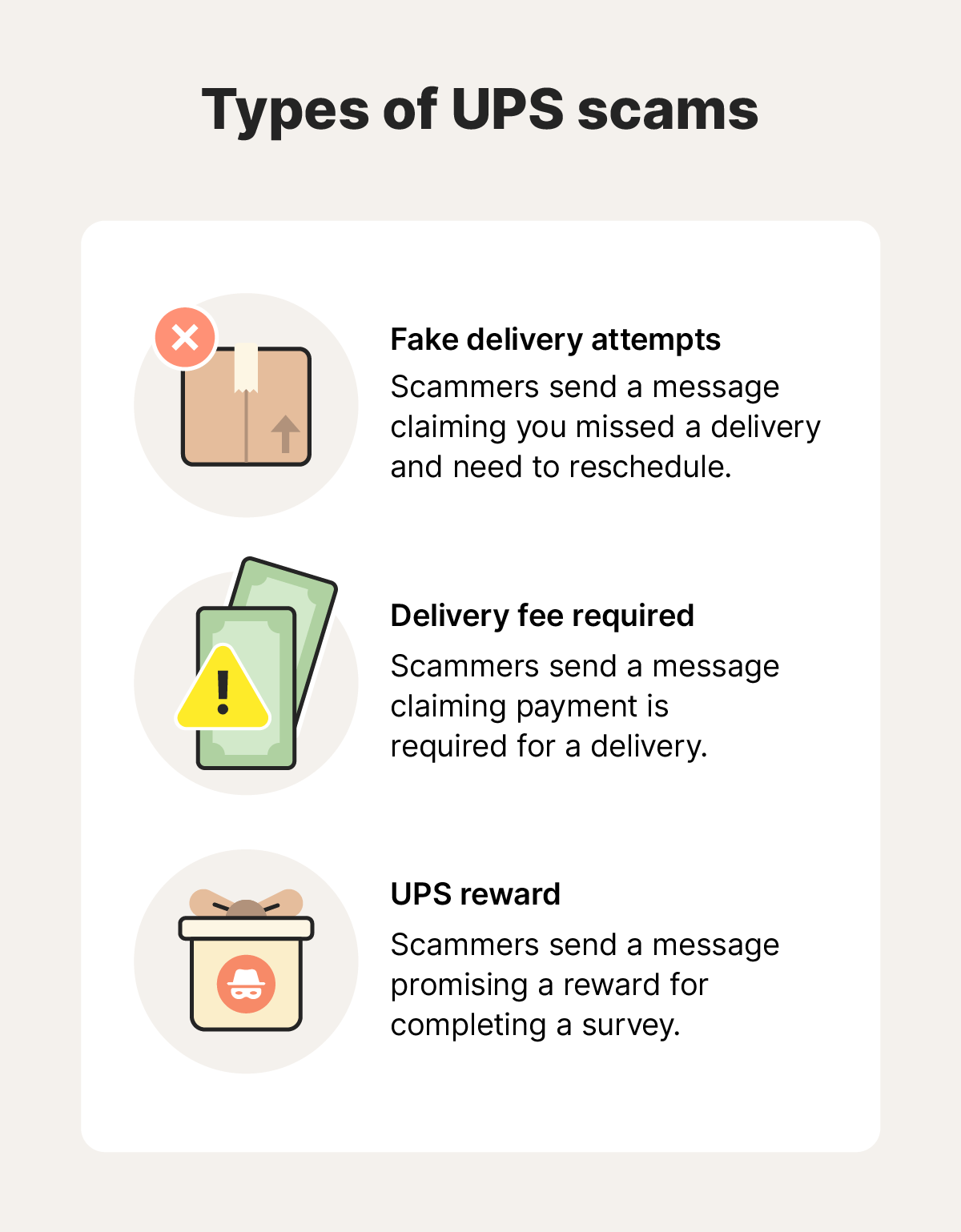
Cybercriminals use various UPS scams to trick unsuspecting victims into providing sensitive personal information, clicking harmful links, or making direct payments. Watch out for the following types of fake UPS texts and emails.
UPS fake delivery attempts
One of the most common UPS scams involves scammers sending a message from a fake UPS email address or phone number claiming you missed a delivery. They’ll often prompt you to click a link to reschedule for another day or update your delivery address, counting on your curiosity to entice you, even if you weren't expecting a delivery.
These messages can look very convincing, often including fake tracking numbers to make them seem legitimate. For example, you might receive a text or email that says something like this:
However real they look, you should never click links included in suspicious texts or emails. If you aren’t expecting a delivery, ignore the message or report it to UPS. If you are, visit the official UPS website and use the UPS tracking system to verify the tracking number in the message.
Delivery fee required scam
Scammers pretending to be from UPS may send you a text or email claiming you owe a delivery or redelivery fee. The message might say you won’t receive your package until you pay, which can be particularly compelling if you’re expectantly awaiting a delivery.
Like other UPS scams, these messages often contain details that make them seem legitimate, like your name, address, or even a company you often purchase from. A delivery fee required scam message might look like this:
Once your initial payment has been processed, UPS will never ask for extra shipping fees, so any message you receive asking for additional payments is sure to be a scam. Ignore the message, block the phone number or email address that sent it, and report it to UPS.
UPS reward scam
UPS reward scams are phishing schemes designed to steal your personal information by promising fake prizes. Typically sent via text or email, these scams link to surveys offering rewards for completion. Instead of a legitimate survey, the link redirects you to a fake UPS website controlled by the scammer.
The original message will often create a sense of urgency by mentioning a time limit for the prize draw, like in this example:
Treat messages about UPS prize draws or rewards with caution. Legitimate competitions are usually announced on the official UPS website or social media accounts. If you receive a suspicious message, don’t engage — ignore it, block the sender, and report the incident to UPS to help prevent further scams.
How to tell if a UPS message is a scam
Although scammers use sophisticated tactics to make it hard to distinguish legitimate messages from scams, there are telltale signs that can help you spot a fake UPS text or email:
- Sense of urgency: Scammers will attempt to trick you into acting without thinking by creating a false sense of urgency. This may include using threats like a delivery getting canceled if you don’t respond.
- Payment requests: UPS will never ask you to make payments for parcels via text message. If you’re prompted to make a payment for a parcel you aren’t expecting, it’s almost certainly a scam.
- Poor grammar and spelling: It’s highly unlikely that a legitimate message from UPS will contain grammar or spelling errors. Treat mistakes or strange phrasing in a message as a red flag that it’s a scam.
- Unexpected messages: UPS will never send unsolicited emails or texts asking for personal information. Additionally, UPS will only text if you have a delivery scheduled and have requested SMS updates.
- Deceptive links: Messages from UPS will only ever include links to legitimate UPS websites, meaning they’ll always start with: https://ups.com, https://billing.ups.com, https://go.ups.com, or http://links4.upsemail.com. Don’t click links leading to any other websites.
How to protect against UPS scams
Being able to recognize the most common UPS scam emails and texts is a great first step in avoiding falling for them. But scammers are always coming up with new approaches, so use the following strategies to help protect yourself from getting duped in the future:
- Don’t respond: Scammers create a sense of urgency or severity to trick you into responding to their messages — don’t fall for it. For questions about payments or deliveries, contact UPS directly using verified contact information.
- Don’t click links: Avoid clicking links in suspicious messages, as they may install malware or redirect you to scam websites designed to steal your personal information. Only trust links leading to the official UPS website.
- Block spam numbers and email addresses: If you recognize a UPS scam message, block the phone number or email address that sent it. This may help reduce the chance of being targeted again by the same scammers.
- Contact UPS directly: If you’re ever unsure about whether a UPS text or email is real, get in touch with UPS for verification. You can call UPS customer support at (800) 742-5877, or visit the UPS online contact center for more options.
- Invest in identity theft protection: LifeLock monitors millions of online data points per second to track where your personal information is used. If a scammer steals your information to commit identity theft, LifeLock’s suspicious activity alerts help you take action quickly to protect yourself and restore your identity.
What to do if you fall for a UPS scam
Were you targeted by a UPS text scam or phishing email? If you’ve clicked a link in a suspicious message, shared personal information, or made a payment, follow these steps to help protect yourself against the consequences of identity theft:
- Update compromised login details: Create new, secure passwords for any accounts that you may have inadvertently given the scammer access to.
- Report the scam: Submit a report to the Federal Trade Commission (FTC) as soon as possible to help prevent further fraud.
- Freeze your credit: Place a credit freeze with all three major bureaus to stop scammers from opening new financial accounts in your name.
- Set a fraud alert: Place a fraud alert on your credit report to prompt lenders to verify your identity before they allow new accounts to be opened in your name.
- Watch your financial accounts: Regularly monitor your bank and credit card accounts for any suspicious or unauthorized transactions.
Stay more secure against scam attempts
Phishing schemes exploit your trust in companies like UPS to deceive you, but LifeLock can help you stay one step ahead of fraudsters.
With powerful identity theft protection and monitoring tools, you’ll get alerts when LifeLock finds that your personal information is used fraudulently so you can act quickly to protect your identity. And, if your identity is ever compromised, you’ll get personalized support from a U.S.-based restoration specialist to help you recover.
FAQs
Does UPS send text messages?
Yes, UPS sends text messages to provide updates about upcoming deliveries. However, they’ll only send you a text message if you’ve actively opted in to receiving SMS notifications, and they’ll never request personal information in a text message.
Does UPS send emails?
Yes, UPS sends emails about upcoming deliveries and to provide other service-related updates. These messages may include a link to track packages, but links in legitimate UPS emails will always start with: https://ups.com, https://billing.ups.com, https://go.ups.com, or http://links4.upsemail.com.
How can I report a UPS scam text message or email?
You can report suspected UPS scams by sending screenshots of suspicious text messages or forwarding suspicious emails to fraud@ups.com. You can also report the scam to the Federal Trade Commission (FTC) or the Better Business Bureau (BBB).
What should I do if I click a link in a UPS scam message?
If you click a suspicious UPS link, first verify you're on the official UPS website. If the web address looks questionable, avoid providing personal information and close the browser immediately. If you've already shared details, update passwords for compromised accounts and watch for unauthorized activity in your financial accounts.
Editors' note: Our articles provide educational information about identity theft, scams, financial fraud, and other topics that can put your identity or personal accounts at risk. LifeLock offerings may not cover or protect against every type of crime, fraud, scam, or threat we write about. For more details about how we write, review, and update our articles, see our Editorial Policy.
Related articles