






 Why do we ask?

Tip: This feature silences all unknown callers, not just scammers, so you may miss genuine calls. To avoid this, add important numbers — like your doctor’s office or your children’s school — to your contacts list.
Has your personal data been recently exposed?
Check if information like your Social Security number, email, and passwords is exposed on the dark web.


You have reached the maximum number of scans allowed. Please come back after 24 hours.

Scanning the dark web...
Scanning public databases...
Scanning millions of records...
Narrowing down the search...
We need more information
Please enter a few more details to ensure we show you the right information.
Risk level:
High
You’re at high risk
We found your personal information on the dark web and on data broker sites.
Your personalized protection plan
Product Benefits:
 Up to $3M Reimbursement for identity theft, with up to $1M for Stolen Funds†††
$10K Scam Reimbursement7
Scam Support
Credit, Checking and Savings Activity Alerts: Unlimited Accounts
Credit & Payday Loan Lock2
Credit Monitoring:
3 Bureau1
Automatic Data Broker Removal8
Dark Web Monitoring
Priority 24/7 Customer Phone Support
Up to $3M Reimbursement for identity theft, with up to $1M for Stolen Funds†††
$10K Scam Reimbursement7
Scam Support
Credit, Checking and Savings Activity Alerts: Unlimited Accounts
Credit & Payday Loan Lock2
Credit Monitoring:
3 Bureau1
Automatic Data Broker Removal8
Dark Web Monitoring
Priority 24/7 Customer Phone Support
LifeLock Total
Your price:
$
349.99
Your price:
$
34.99
60-day money back guarantee with an annual plan
24/7 Live Member Support
No one can prevent all cybercrime or prevent all identity theft.
- Price valid for introductory term. After that, your price will renew at the standard price.
- Your subscription begins immediately after your transaction is complete. A payment method is required at sign-up for trials, and you will be charged at the end of your trial, unless canceled first.
- Prices are subject to change and may be charged up to 35 days prior to renewal. Cancel here or contact Member Services.
- Restrictions apply. Automatically renewing subscription required. If you're a victim of identity theft and not satisfied with our resolution, you may receive a refund for the current term of your subscription. See lifelock.norton.com/guarantee for complete details.
††† Up to $1 million coverage for Lawyers and Experts included with all plans. Reimbursement and expense compensation vary according to plan. Insurance benefits are issued by third parties. See lifelock.norton.com/legal for policy info.
1 Bureau Monitoring and Monthly Credit Report and Score / 3 Bureau Monitoring and Monthly Credit Report and Score.
2 Credit Lock cannot prevent all account takeovers, unauthorized account openings, or credit file inquiries. Deactivates if you downgrade or cancel your subscription.
7 Scam protection coverage as part of identity theft benefits is currently available to all customers residing in the United States, including U.S. territories and the District of Columbia, with the exception of residents of New York. Gen Digital is not a licensed insurance producer. Benefits under the Master Policy are issued and covered by HSB Specialty Insurance Company. You can find further details and exclusions in the summary of benefits.
8 After setup, automatic data broker removal service scans and requests removal every 90 days.
Risk level:
Medium
You’re at medium risk
We found your personal information on data broker sites.
Your personalized protection plan
Product Benefits:
Up to $1.2M Reimbursement for identity theft, with up to $100K for Stolen Funds†††
$5K Scam Reimbursement7
Scam Support
Credit, Checking and Savings Activity Alerts:
5 Accounts
Credit & Payday Loan Lock2
Credit Monitoring:
3 Bureau1
Automatic Data Broker Removal8
Dark Web Monitoring
Priority 24/7 Customer Phone Support
LifeLock Advanced
Your price:
$
199.99
Your price:
$
19.99
60-day money back guarantee with an annual plan
24/7 Live Member Support
No one can prevent all cybercrime or prevent all identity theft.
- Price valid for introductory term. After that, your price will renew at the standard price.
- Your subscription begins immediately after your transaction is complete. A payment method is required at sign-up for trials, and you will be charged at the end of your trial, unless canceled first.
- Prices are subject to change and may be charged up to 35 days prior to renewal. Cancel here or contact Member Services.
- Restrictions apply. Automatically renewing subscription required. If you're a victim of identity theft and not satisfied with our resolution, you may receive a refund for the current term of your subscription. See lifelock.norton.com/guarantee for complete details.
††† Up to $1 million coverage for Lawyers and Experts included with all plans. Reimbursement and expense compensation vary according to plan. Insurance benefits are issued by third parties. See lifelock.norton.com/legal for policy info.
1 Bureau Monitoring and Monthly Credit Report and Score / 3 Bureau Monitoring and Monthly Credit Report and Score.
2 Credit Lock cannot prevent all account takeovers, unauthorized account openings, or credit file inquiries. Deactivates if you downgrade or cancel your subscription.
7 Scam protection coverage as part of identity theft benefits is currently available to all customers residing in the United States, including U.S. territories and the District of Columbia, with the exception of residents of New York. Gen Digital is not a licensed insurance producer. Benefits under the Master Policy are issued and covered by HSB Specialty Insurance Company. You can find further details and exclusions in the summary of benefits.
8 After setup, automatic data broker removal service scans and requests removal every 90 days.
Risk level:
Low
Good news!
We didn’t find your personal information across millions of records or on public data sources.
Your personalized protection plan
Product Benefits:
Up to $1.05M Reimbursement for identity theft, with up to $25K for Stolen Funds†††
Identity Restoration Specialists
Credit, Checking and Savings Activity Alerts:
2 Accounts
Credit & Payday Loan Lock2
Credit Monitoring:
2 Bureau1
Automatic Data Broker Removal8
Dark Web Monitoring
Breach Alerts
24/7 Customer Phone Support
Lifelock Core
Your price:
$
124.99
Your price:
$
12.49
60-day money back guarantee with an annual plan
24/7 Live Member Support
No one can prevent all cybercrime or prevent all identity theft.
- Price valid for introductory term. After that, your price will renew at the standard price.
- Your subscription begins immediately after your transaction is complete. A payment method is required at sign-up for trials, and you will be charged at the end of your trial, unless canceled first.
- Prices are subject to change and may be charged up to 35 days prior to renewal. Cancel here or contact Member Services.
- Restrictions apply. Automatically renewing subscription required. If you're a victim of identity theft and not satisfied with our resolution, you may receive a refund for the current term of your subscription. See lifelock.norton.com/guarantee for complete details.
††† Up to $1 million coverage for Lawyers and Experts included with all plans. Reimbursement and expense compensation vary according to plan. Insurance benefits are issued by third parties. See lifelock.norton.com/legal for policy info.
1 Credit features require successful setup, identity verification, and sufficient credit history by the appropriate credit bureau. Credit monitoring features may take several days to activate after enrollment.
2 Identity Lock cannot prevent all account takeovers, unauthorized account openings, or credit file inquiries. Deactivates if you downgrade or cancel your subscription.
8 After setup, automatic data broker removal service scans and requests removal every 90 days.
1/2
Finding your match...

DID YOU KNOW?
10 cents
If your information is exposed or stolen in a data breach, it can end up on the dark web where it can be sold for as little as 10 cents.
100M+
LifeLock monitors hundreds of millions of data points a second.
Based on your concerns, the best plan for you is:
LifeLock Core
(Individual)
LifeLock Advanced
(Individual)
LifeLock Total
(Individual)
LifeLock Core
(2 adults)
LifeLock Advanced
(2 adults)
LifeLock Total
(2 adults)
LifeLock Core
(2 adults + up to 10 kids)
LifeLock Advanced
(2 adults + up to 10 kids)
LifeLock Total
(2 adults + up to 10 kids)
Pricing details below*
Pricing details below*
Pricing details below*
Pricing details below*
Pricing details below*
Pricing details below*
Pricing details below*
Pricing details below*
Pricing details below*
- Up to $1.05M Reimbursement for identity theft, with up to $25K for Stolen Funds†††
- Up to $1.2M Reimbursement for identity theft, with up to $100K for Stolen Funds†††
- Up to $3M Reimbursement for identity theft, with up to $1M for Stolen Funds†††
- Up to $1.05M Reimbursement for identity theft, with up to $25K for Stolen Funds††† for each adult
- Up to $1.2M Reimbursement for identity theft, with up to $100K for Stolen Funds††† for each adult
- Up to $3M Reimbursement for identity theft, with up to $1M for Stolen Funds††† for each adult
- Up to $1.05M Reimbursement for identity theft, with up to $25K for Stolen Funds††† for each adult
- Up to $1.2M Reimbursement for identity theft, with up to $100K for Stolen Funds††† for each adult
- Up to $3M Reimbursement for identity theft, with up to $1M for Stolen Funds††† for each adult
- Credit Monitoring Coverage1
- Credit Monitoring1 each adult
- Credit Monitoring1 for family
- Credit, Checking & Savings Account Activity Alerts
- Credit, Checking and Savings Activity Alerts for each adult
- Credit, Checking and Savings Activity Alerts for family
- 401K & Investment Account Activity Alerts
- 401K/Investment Account Alerts for each adult
- 401K/Investment Account Alerts for family
- Recurring and Unusual Charge Alerts
- Unexpected & Suspicious Charge Alerts for each adult
- Unexpected & Suspicious Charge Alerts for family
- Stolen Funds Reimbursement†††
- Stolen Funds Reimbursement††† for each adult
- Stolen Funds Reimbursement††† for family
- Lawyers and Experts†††
- Lawyers & Experts††† for each adult
- Lawyers & Experts††† for family
- Automatic Data Broker Removal8
- Automatic Data Broker Removal8 for each adult
- Automatic Data Broker Removal8 for family
- Scam Reimbursement7
- Scam Reimbursement7 for each adult
- Scam Reimbursement7 for family
- Credit Reports & Scores1
- Credit Report & Score for each adult
- Credit Report & Score for family
- Social Media Monitoring
- Social Media Monitoring for each adult
- Social Media Monitoring for family

We have more plans to choose from.
See all plans

Have questions?
Contact sales
*Your subscription begins immediately after payment and automatically renews unless cancelled. Discount for annual plans are compared to monthly billing. Prices subject to change and may be charged up to 35 days before current term ends. Cancel here or contact Member Services.
††† Up to $1 million coverage for Lawyers and Experts included with all plans. Reimbursement and expense compensation vary according to plan. Insurance benefits are issued by third parties. See LifeLock.Norton.com/legal for policy info.
1 Credit features require successful setup, identity verification and sufficient credit history by the appropriate credit bureau. Credit monitoring features may take several days to activate after enrollment.
7 Scam protection coverage as part of identity theft benefits is currently available to all customers residing in the United States, including U.S. territories and the District of Columbia, with the exception of residents of New York. Gen Digital is not a licensed insurance producer. Benefits under the Master Policy are issued and covered by HSB Specialty Insurance Company. You can find further details and exclusions in the Summary of Benefits.
8 After setup, automatic data broker removal service scans and requests removal every 90 days.
Why do we ask?
Identifying your concerns gives us the ability to recommend the right plan for your needs.
Return to quiz
Why do we ask?
Knowing this number helps us recommend coverage that fits your needs.
Return to quiz
Why do we ask?
Providing your email address makes you eligible for notifications of potential identity threats.
Return to quiz
Scam call numbers to block in 2025
Scam calls might feel unavoidable, but there’s plenty you can do to minimize the risk of falling for them. Get insights into common scam call numbers to block and tips that can help you protect against phone scammers. Then get LifeLock for powerful privacy monitoring features you can use to reduce exposure of your phone number.


Scam and spam calls are more than just an annoyance — they can also expose you to sophisticated schemes that target your identity or finances. TrueCaller’s 2024 Spam and Scam survey suggests that 21% of Americans lost money to a scam call in 2023, resulting in total losses of $25 billion.
Knowing how to identify and block scam call numbers can help you avoid joining the list of victims. This first involves familiarizing yourself with common scam phone numbers, and then learning how to detect and avoid suspicious calls.
What are the area codes to avoid?
Although scammers can call from anywhere in the world, some area and country codes are more closely associated with scam calls. Knowing these codes can help you recognize and avoid potential phone scams.
Here are some country codes commonly used in scam call schemes:
- +7: Russia
- +91: India
- +92: Pakistan
- +232: Sierra Leone
- +234: Nigeria
- +257: Burundi
- +265: Malawi
- +355: Albania
- +375: Belarus
- +1 242: Bahamas
- +1 268: Antigua and Barbuda
- +1 284: British Virgin Islands
- +1 441: Bermuda
- +1 473: Grenada
- +1 649: Turks and Caicos
- +1 664: Montserrat
- +1 721: St. Maarten
- +1 758: St. Lucia
- +1 767: Dominica
- +1 784: St. Vincent and the Grenadines
- +1 809, +1 829, +1 849: Dominican Republic
- +1 868: Trinidad and Tobago
- +1 869: St. Kitts and Nevis
- +1 876: Jamaica
However, not all scam calls come from abroad and even scammers that are calling from other countries can spoof their number so it appears to have a United States area code.
Here are some U.S. area codes that are often associated with phone scams:
- (214), (469), (972): Dallas, Texas
- (216): Cleveland, Ohio
- (218): Duluth, Minnesota
- (332), (347), (646): New York City, New York
- (657): Anaheim, California
- (712): Sioux City, Iowa
Remember that these lists aren’t comprehensive. Not all calls coming from numbers with these country or area codes will be scams, and not all scam calls will come from numbers with these codes.
What are the most frequently used scam call numbers?
According to a report by BeenVerified, there are 12 phone numbers that are commonly associated with phone scams and smishing text messages:
- (202) 221-7923: This number is linked to student loan forgiveness scams that warn of a fake payment deadline, creating a false sense of urgency.
- (301) 307-4601: This number is associated with USPS scam texts that claim there was a delivery issue.
- (312) 339-1227: This number has been linked to both delivery scams and scams promoting fake weight loss products.
- (347) 437-1689: Reports link this number to tax scams that trick recipients into clicking malicious links.
- (469) 709-7630: Scammers use this phone number to impersonate delivery services, claiming they couldn’t deliver a package. This prompts recipients to take action to resolve the issue.
- (805) 637-7243: This number is associated with Publisher’s Clearing House scams and calls impersonating Visa’s fraud department.
- (858) 605-9622: Scammers use this phone number to send fake bank text messages that claim your account is on hold.
- (863) 532-7969: Recipients report that this number claimed their debit card was frozen, prompting them to reveal sensitive information to unfreeze it.
- (865) 630-4266: This phone number is linked to bank scams impersonating Wells Fargo. The scammers claim that an account is locked and urge their potential victims to call back immediately.
- (878) 877-1402: Recipients report that this number attempted to get them to reveal their PIN by posing as a credit card issuer.
- (904) 495-2559: Scammers use this number to claim that their targets won a fake AT&T raffle.
How to identify scam numbers
While familiarizing yourself with common numbers scammers use is helpful, it’s unlikely you’ll be able to memorize them all. Instead, follow these simple tips to help identify phone scams and protect against identity theft:
1. Check the caller ID
The caller ID features offered by cell phone carriers — like Verizon’s Call Filter and AT&T’s ActiveArmor — can help flag potential scam calls. These carriers draw from extensive databases of known scam call numbers to automatically apply a label to suspicious incoming calls.
Verizon labels them “Potential Spam,” while other providers may use different phrases, like “Scam Likely” and “Potential Fraud.” Generally, it’s best not to answer a call with any of these labels. If it’s a genuine caller, they’re likely to leave a voicemail or try again later.
Many smartphones also offer enhanced caller ID features. Most Android phones, for example, benefit from a spam protection filter that’s activated by default. Apple also makes it easy to block or avoid unwanted calls on iPhones.
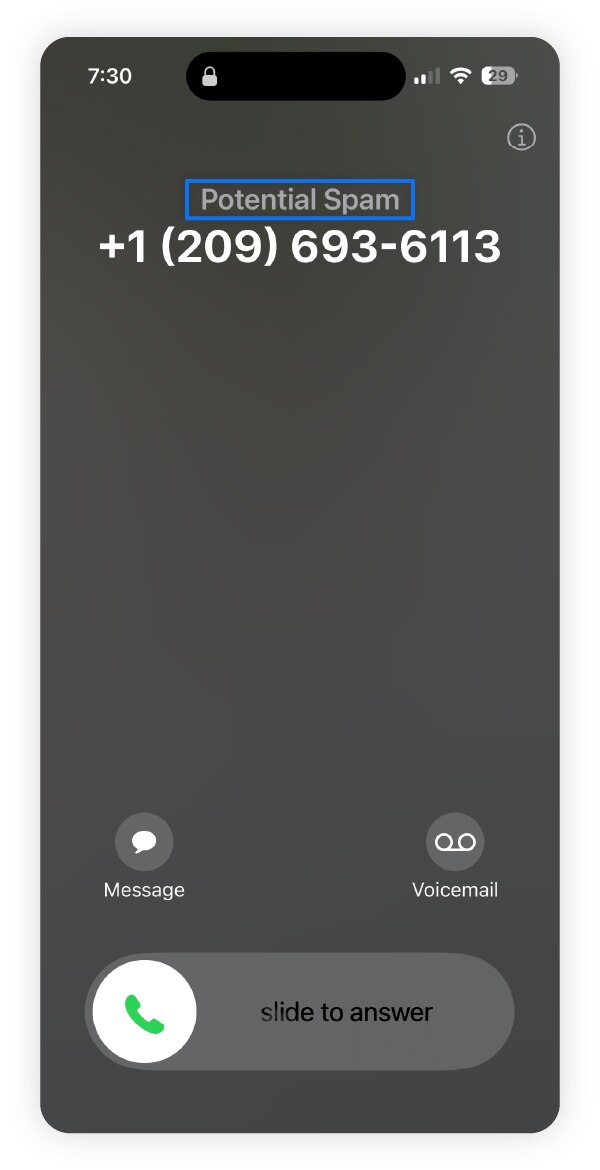
“Potential spam” label on iPhone, which could potentially be a scam call.
2. Note the area code
If you receive a call from a number with a country or area code you have no ties to, it might be a scam or spam call you can safely ignore. Although it’s possible that it’s a legitimate call from a service provider or business, genuine callers who need to reach you can always leave a voicemail or contact you another way.
With that said, it’s also important to stay cautious of local numbers and numbers you recognize. Scammers can use a technique called phone number spoofing to route their calls through a number with a specific area code or caller ID information, making it look like they’re calling from a local number or even a trusted entity.
3. Look up the number online
If you’re unsure whether a number is legitimate, try searching it online. Websites like Truecaller, Scammer Info, and /r/ScamNumbers on Reddit let users report numbers they’ve received scam calls from. If other people have flagged the number calling you, it should show up in search results.
If you answer a call from someone claiming to be from a specific business or government agency, look up the official contact number on their website to verify they’re telling the truth. But remember, fraudsters can also manipulate the caller ID information to appear trustworthy. If you have any doubts, you can always hang up and then call the number on the official website to confirm if the previous caller was genuine.
How to block scam numbers
If you’re tired of your phone constantly ringing due to scam and spam calls, use these techniques to block or silence them:
Block scam call numbers
All major mobile devices allow you to block specific phone numbers, giving you an easy way to gradually filter out known scammers. Here’s how to do it on Android and iPhone:
On Android:
- Open the Phone app.
- Find the scam number in your call history and long-press it.
- Tap Block/report spam from the menu, check the box to flag it as spam, and tap Block.
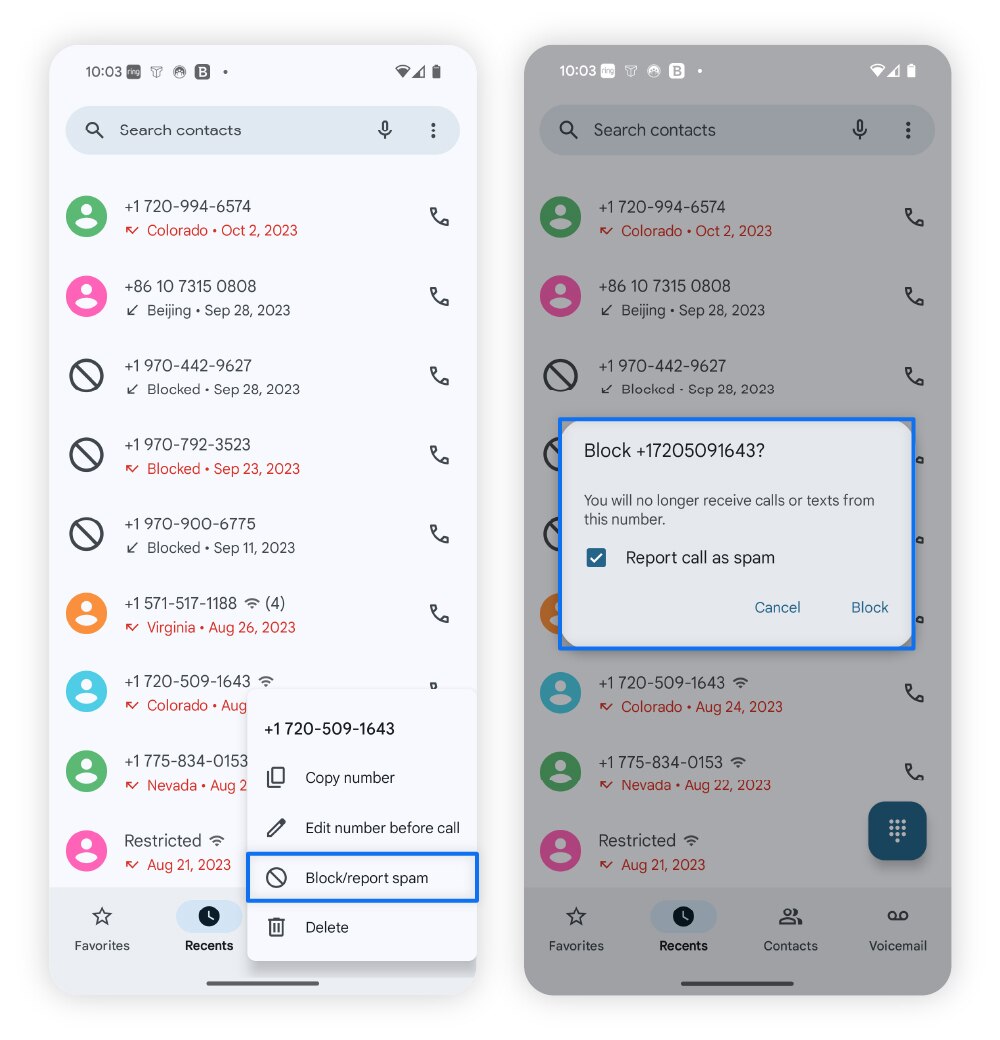
Screenshots showing how to block a scam number on an Android phone.
On iOS:
- Open the Phone app.
- Tap Recents.
- Identify the scam number you want to block and tap the blue icon with a small circle and a lowercase letter “i” inside.
- Scroll down and tap the red text that says Block Caller and then tap Block Contact.
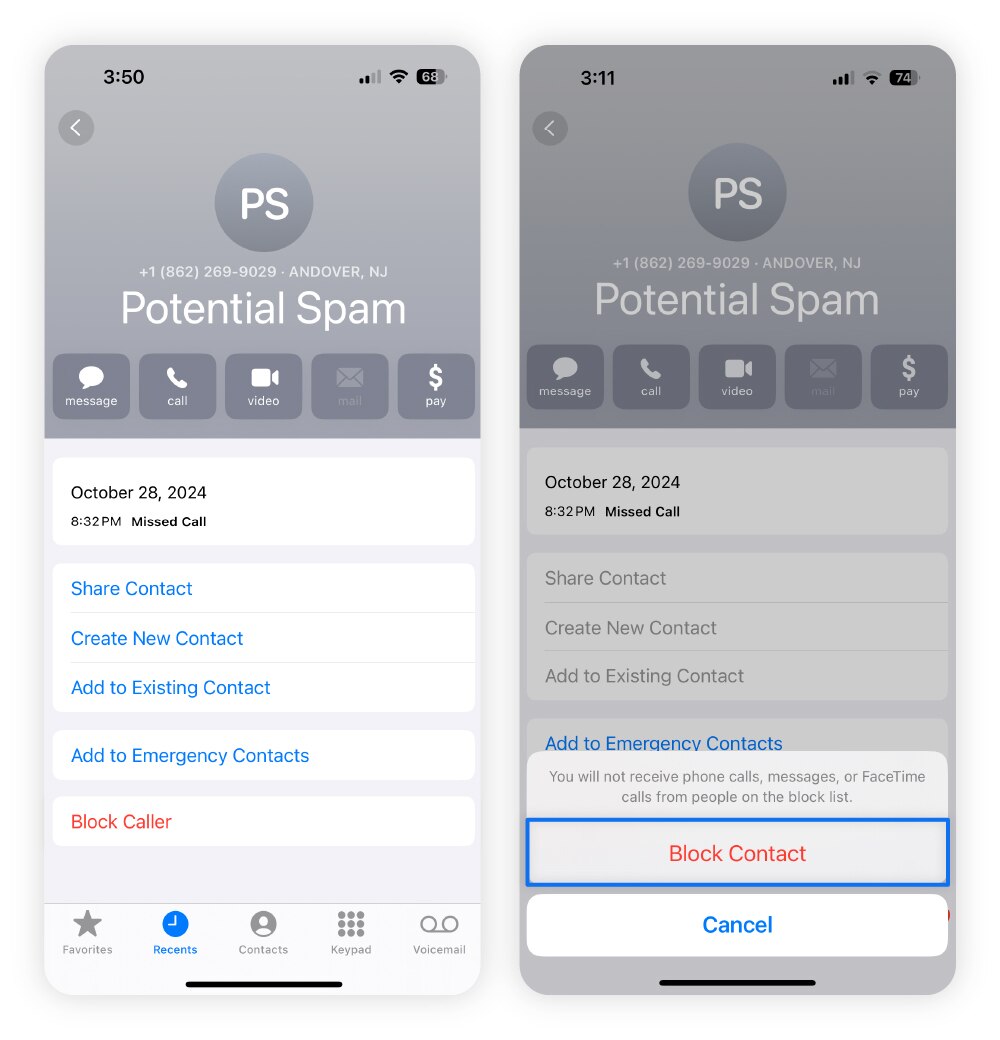
Screenshots showing how to block a scam number on an iPhone.
Download a call-blocking app
You can download a call-blocking app to bolster your device’s caller ID features and filter potential scam calls before you receive them. These apps use call data, user reports, information from the Federal Trade Commission (FTC), and other sources to detect potential scam call numbers.
Most popular mobile carriers offer their own caller ID apps which typically include call-blocking features:
- Verizon Call Filter: Available for free with basic features or starting at $3.99 per line for the Plus version.
- AT&T ActiveArmor: Included with unlimited rate plans or available for subscriptions starting at $3.99 per month.
- T-Mobile Scam Shield: Free for all T-Mobile postpaid customers.
You can also choose from a range of trusted third-party call-blocking apps available on the Google Play store or App Store, like Hiya or Robokiller.* These apps generally let you choose how to handle potential scam calls — with options like silencing, blocking, or sending them straight to voicemail.
Silence unknown callers
Silencing unknown callers on your phone is a simple and free way to reduce the chances of accidentally answering a scam call. Enabling this feature means your phone will automatically silence any incoming calls from numbers not in your contacts list.
Here’s how to silence unknown callers:
On Android:
- Navigate to the Phone app and tap the three-dot menu.
- Tap Settings in the menu options.
- Tap Block Numbers and then toggle on Block Unknown Callers.
On iOS:
- Navigate to the Settings app and tap the Phone menu item.
- Scroll down to the section Call Silencing and Blocked Contacts, then toggle on Silence Unknown Callers.
While this won’t stop scammers from trying to call you, all incoming calls from unknown numbers won’t ring or show up on your screen. They’ll still show up in your recent calls list, and callers can leave a voicemail.
Other ways to stop scam calls
Aside from blocking or silencing numbers, there are other key steps to reduce the number of scam or spam calls you receive. The most impactful strategies include:
- Avoid answering scam calls: Ignoring incoming calls you suspect are scams or spam can help reduce their frequency. This signals to the scammers that your number isn’t a good target, potentially leading them to remove you from their list.
- Join the Do Not Call Registry: The National Do Not Call Registry is a database managed by the FTC that allows you to register your phone number for free to opt out of telemarketing calls. While scammers can ignore this list, it should reduce the number of spam calls you receive.
- Share your number only when essential: Avoid using your phone number when creating new online accounts to reduce the chance of your details being leaked in a data breach and used in scams or sold by hackers.
What to do if you answer a scam call
Remember that caller ID can be spoofed to make it look like the call is from a government agency or local number, so it’s not always possible to identify a scam call before you answer. If you accidentally answer a scam call, don’t panic. Here’s what to do:
- Don’t share personal information: Never provide personally identifiable information like your Social Security number, credit card number, or passport number on an unsolicited call. If you think the call’s legitimate, hang up and call back at a number available on the organization’s website.
- Hang up immediately: If you realize that you’re on the phone with a scammer, hang up straight away to help avoid falling for their scheme.
- Block the number: After you hang up on a suspected scam caller, block the number to avoid receiving additional calls from them.
- Monitor your credit: If you accidentally share personal information with a potential scammer, monitor your credit and financial accounts, freeze your credit with the bureaus, and look out for potential signs of identity theft.
- Report the scam: If a scam financially impacted you, report it to the Federal Trade Commission at reportfraud.ftc.gov.
Help protect your identity from scam callers
Knowing how to identify scam calls is essential, but trying to avoid them is even better. With LifeLock, you can monitor† online exposure of your personal information, including your phone number, so you can take steps to reduce your vulnerability to scam callers.
LifeLock also offers a range of powerful identity theft protection features, including credit monitoring and alerts for fraudulent use of your Social Security number, so you can protect against the risks of identity theft. And if your identity is ever stolen through a scam, one of our expert U.S.-based restoration specialists will help you recover.
FAQs
How do scammers spoof phone numbers?
Most scammers spoof phone numbers using Voice over Internet Protocol (VoIP) services, which allow them to change the number or name that appears on a caller ID so that it looks more trustworthy or legitimate.
Why do I keep getting scam calls?
If you receive a high volume of scam calls, it may be because you answered a scam call in the past which alerted the scammer that your number is active. This can prompt the scammer to sell your number on the dark web, further compromising your privacy.
Where can I report scam phone numbers?
You can report scam phone numbers to the FTC by visiting reportfraud.ftc.gov or dialing (877) FTC-HELP.
Can a scammer get into your phone from a call?
It’s unlikely someone can hack your phone simply by calling you. However, “SIM swapping” scams and social engineering schemes often involve phone calls that aim to gather information from you that can later be used in a hacking attempt.
* The inclusion of websites, apps, or links does not imply endorsement or support of any company, material, product, and/or provider listed herein.
† LifeLock does not monitor all transactions at all businesses.
Editors' note: Our articles provide educational information about identity theft, scams, financial fraud, and other topics that can put your identity or personal accounts at risk. LifeLock offerings may not cover or protect against every type of crime, fraud, scam, or threat we write about. For more details about how we write, review, and update our articles, see our Editorial Policy.
Related articles


